
What comes after the yottabyte?
I was reviewing the data storage requirements for a project recently which had me talking in terabytes, and thinking long-term in petabytes. For those of you who don’t know, tera- and peta- are the binary prefixes for measuring units of digital information that come after giga- (as in “gigabyte”).
The list of prefixes, which most people started using with the term “kilobyte,” are collectively called the SI Prefixes. SI prefixes are defined under the International System of Units (“SI” for short), which is maintained by the International Bureau of Weights and Measures.
But there’s a problem; currently the list has 5 more prefixes past giga: tera, peta, exa, zetta, and yotta. Translation: we’re out of prefixes in just a few more generations, probably faster if Moore’s Law has anything to say about it. Indeed, you may have noticed how much quicker the public dialog went from megabyte to gigabyte than it did to make the same transition from kilobyte to megabyte. What to do?
One answer is to draw from existing lists of unofficial prefixes, currently used mostly by theoretical mathematicians. But given the speed at which we are advancing, it is safe to assume that we’re going to speed through individual prefixes quickly, resulting in more terminology overlap in common vernacular. For example, data centers are already discussing their capacity in the petabyte and exabyte range, and we haven’t even seen those hit mainstream yet.
Therefore I posit that it’s worth considering using a system that has inherent ordering, i.e. an existing list that we can repurpose. This speeds adoption, eliminates confusion, and solidifies the naming convention for a much longer period with minimal effort.
Looking at the problem in this light, I quickly identified the Greek Alphabet as very viable candidate:
- Current SI prefixes match mnemonically with Greek letters (you can hear the similarity between “gigabyte” and “thetabyte”).
- The list is universal, eliminating the need to debate on future prefix selection and ordering.
- It can instantly extend the SI prefix list another 24 levels.
- The Greeks themselves attached numerical values to each letter.
- There is some precedent: The National Weather Service names tropical storms after Greek letters once the annual A-Z naming list is exhausted.
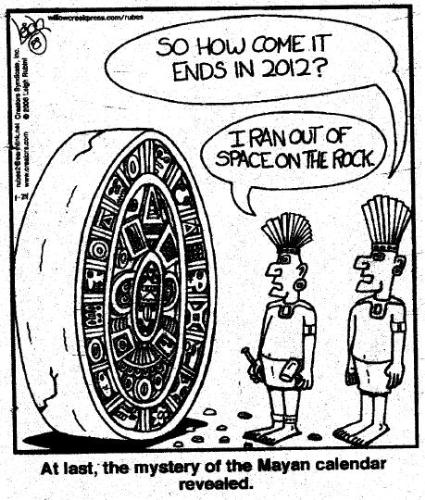
Best of all, the doomsayers of the future might point to the Omegabyte as a sign of the end times. I think I know what the Mayan’s were thinking:
Additional reading and sources:
comments powered by Disqus